This file documents the electricity crisis in Hadramout Governorate, one of the most prominent service-related issues to affect residents’ lives and the stability of economic and commercial activities and public institutions, amid mounting challenges related to generation capacity, fuel supplies, the efficiency of transmission and distribution networks, and maintenance and operations.
The file traces the most significant developments in the electricity sector along the coast, in the valley and in the desert areas of Hadramout, including recurring outages, generating plants going offline, public protests, government decisions, local and external interventions, and announced projects to improve the energy system.
The file also follows these developments through a documented timeline.
A new 800-kilowatt generator arrived in Daw'an District, Hadramout Governorate, on Thursday, November 5, 2026, in a step aimed at boosting generation capacity, improving the stability of electricity service, reducing recurring outages, and preparing for increased energy demand during the summer.
The electricity crisis in Wadi Hadramout reached severe levels in late July 2026, after the Public Electricity Corporation revealed that diesel supplies covered only about half of actual needs, forcing it to reduce generator operation amid a widespread generation deficit and an outage schedule that at some times reached seven hours without power for every three hours of operation.
On the evening of Thursday, July 2, 2026, convoys carrying emergency electricity generators provided by the Kingdom of Saudi Arabia arrived in Al Mukalla City, amid a public reception featuring celebrations and fireworks. Their arrival is part of a project to boost electricity generation on the Hadramout coast, with a planned capacity of 100 megawatts, ahead of transporting the equipment to the power station sites, completing its installation, and connecting it to the public grid.
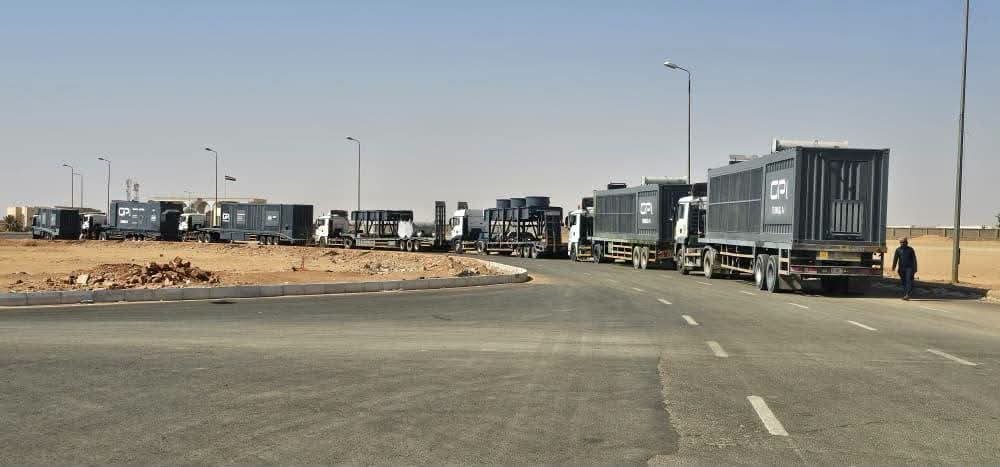
Hadramout Governorate received on Wednesday, July 1, 2026, the first batch of emergency electricity generators arriving from the Kingdom of Saudi Arabia via the Al Wadiah land crossing, as part of a project to provide a total generating capacity of 200 megawatts, divided equally between the coast and the valley. The step marks the project’s transition from the announcement and preparation phase to the arrival of equipment, ahead of its installation and operation.
1 photo
About this file
The electricity crisis in Hadramout did not emerge in a single period. Rather, it resulted from mounting challenges in the energy sector over many years, amid the expansion of cities and population centers and rising demand for electricity, against a backdrop of limited investment in developing generation capacity and transmission and distribution networks, as well as the operational and financial burdens faced by the institutions concerned.
As economic and service conditions in Yemen deteriorated during the years of war, pressure on Hadramout’s electricity system increased. Problems with fuel supplies, the aging of some generating units, inadequate maintenance, and reliance on purchased power emerged as key factors behind the ongoing gap between production and consumption. A study published by the Sana’a Center for Strategic Studies in 2023 examined aspects of the financial and operational imbalances in the governorate’s electricity sector.
In Wadi Hadramout, the opening of the PetroMasila gas-fired power plant, with a design capacity of 75 megawatts, in 2018 marked a significant milestone in the sector’s development, amid hopes of reducing the deficit and improving service stability. However, continued growth in demand and the need to maintain power plants and develop networks kept electricity among the priorities of residents and the authorities concerned.
On the Hadramout coast, the electricity system experienced recurring crises, some linked to fuel shortages and generating units going offline, leading to longer outages, particularly during periods of high temperatures. These challenges became acute in summer 2025, when local authorities discussed declining generation and the shutdown of several generators at different plants.
The crisis took on additional dimensions as the operation of some gas-fired plants was linked to the stability of oil production. In December 2025, PetroMasila announced that gas supplies needed to operate plants in Wadi Hadramout had stopped following security disturbances that affected its operations in the oil blocks, before announcing the gradual resumption of operations as security conditions improved.
Technical challenges continued in 2026, as the Wadi Hadramout system experienced malfunctions that affected generation capacity. These included a fault in the gas system at the PetroMasila plant in September, which caused an additional temporary deficit estimated at about 40 megawatts, according to the Electricity Corporation.
Between announced expansion and rehabilitation projects and recurring breakdowns and fuel crises, the electricity sector in Hadramout continued to face the challenge of moving from emergency measures to long-term solutions that ensure stable generation, develop networks, and improve operational efficiency.
This file documents these developments in a comprehensive timeline, tracing the stages of the crisis and the decisions made to address it, comparing announced projects with what has been achieved on the ground, and highlighting their effects on residents, public services, and the local economy.
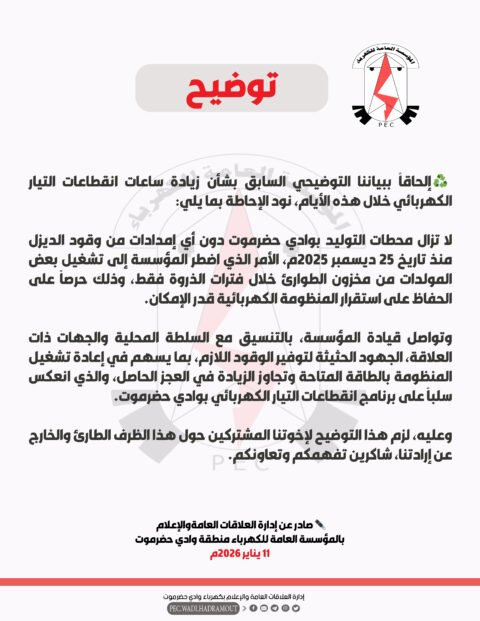
Wadi Hadramout’s electricity system entered 2026 under mounting operational pressure after the Public Electricity Corporation revealed that diesel supplies to power stations had been cut off since December 25, 2025. The corporation was forced to rely on emergency stocks during peak hours, leading to a higher electricity deficit and more outages across the valley.
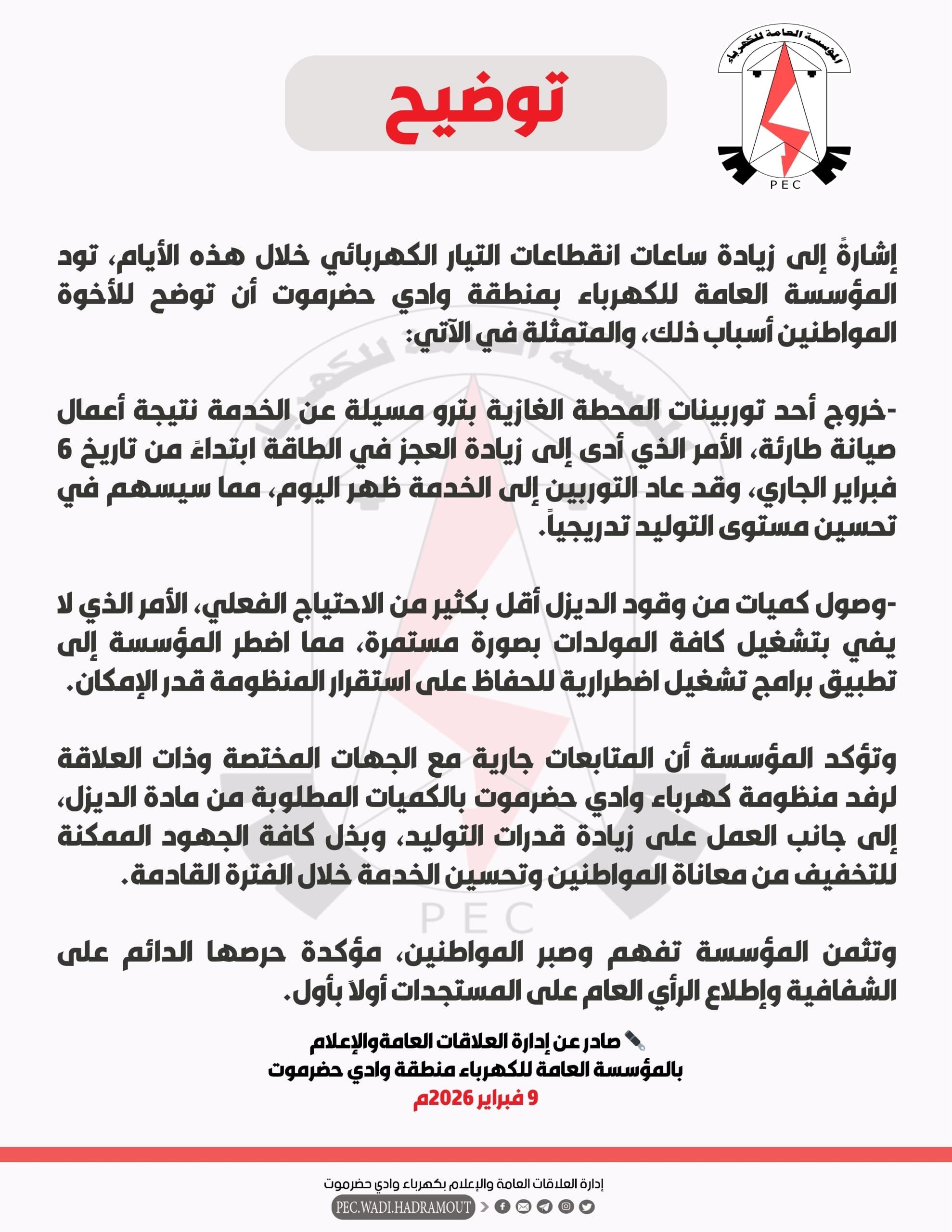
The electricity crisis in Wadi Hadramout worsened after one of the turbines at the PetroMasila gas-fired power station went out of service on February 6, 2026, for emergency maintenance, amid continuing shortages of diesel fuel. This increased the generation deficit and lengthened power outages, before the turbine was returned to service on the afternoon of February 9, with expectations of a gradual improvement in electricity supply.
Heavy rain accompanied by winds and hail on the afternoon of Wednesday, March 25, 2026, caused a general failure in the Wadi Hadramout electricity system at 3:30 p.m., taking the gas-fired power stations and diesel generators out of service and prompting technical teams to begin inspections to determine the cause of the fault and gradually restore power.
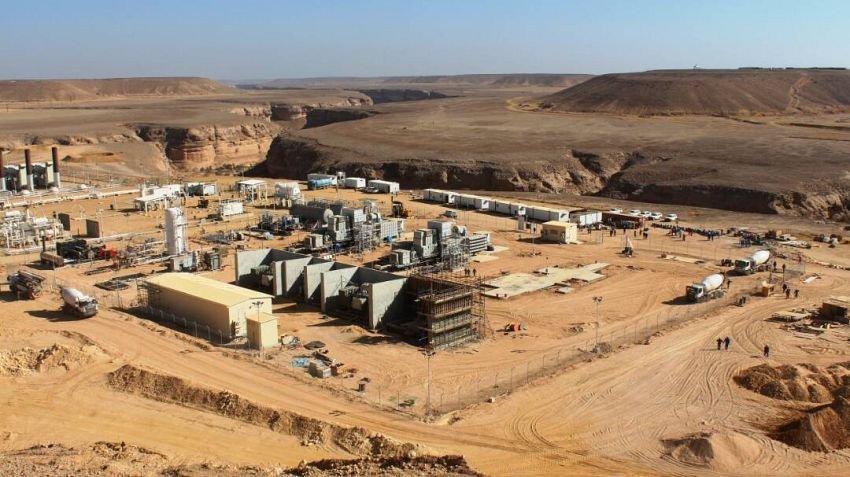
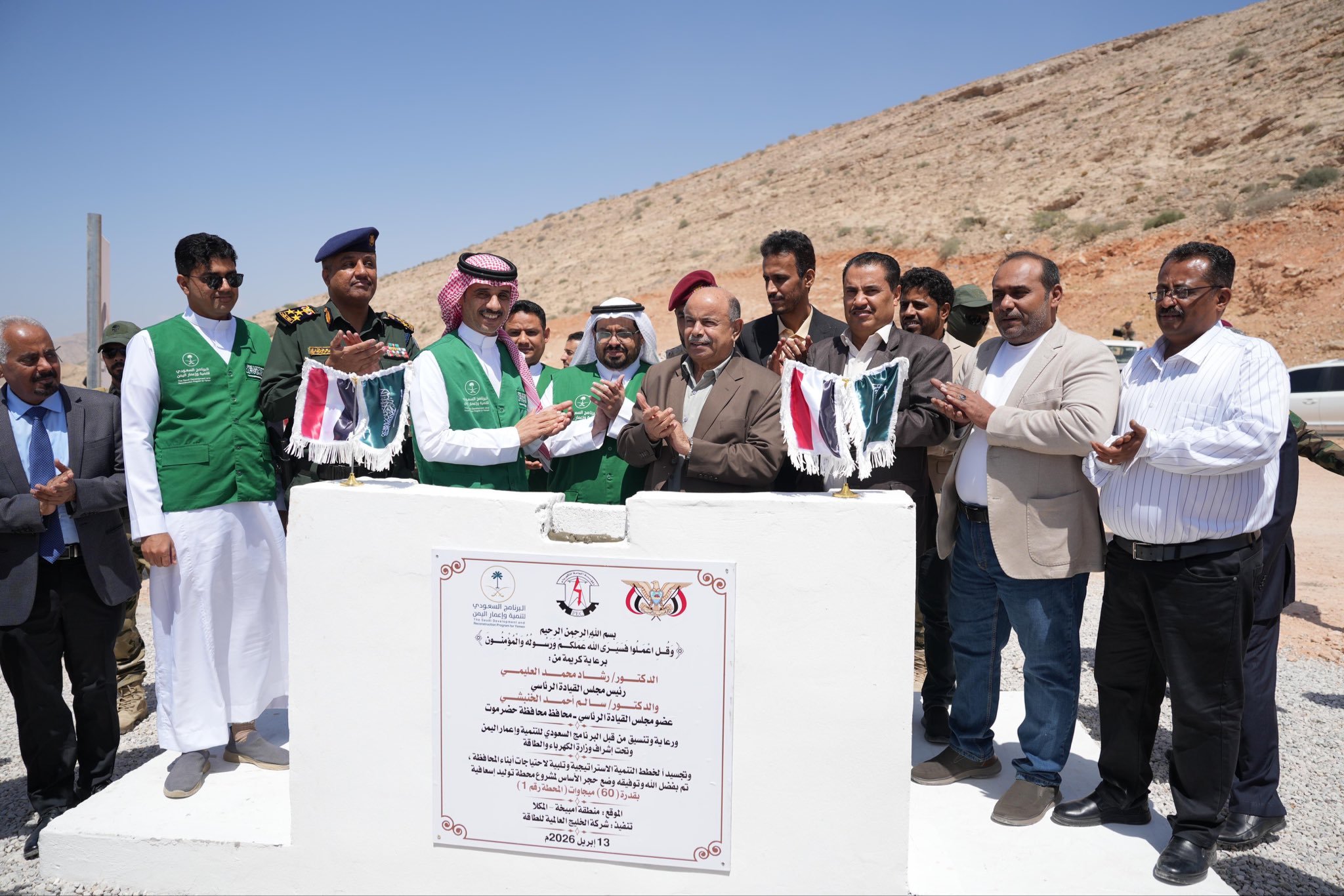
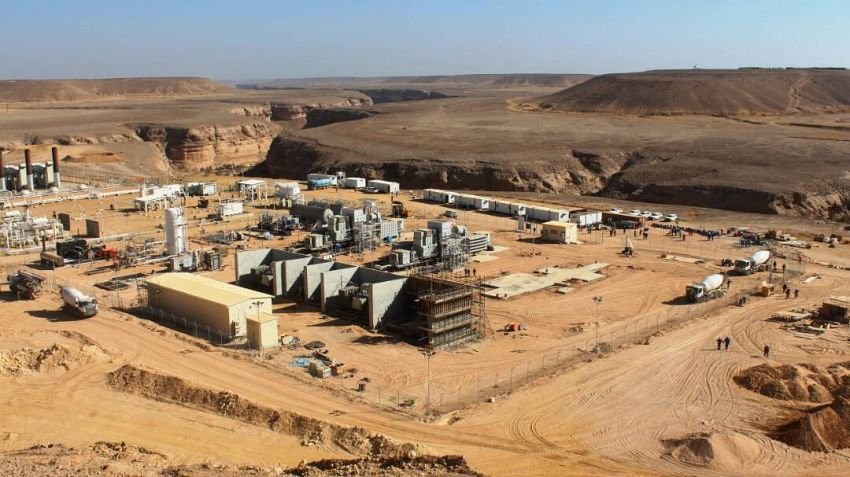
The city of Seiyun witnessed on Wednesday, April 15, 2026, the laying of the foundation stone for a project to build two emergency electricity generation plants with a combined capacity of 100 megawatts, split between Al-Ghurf in Tarim District, with a capacity of 60 megawatts, and Badrah in Wadi Al Ayn and Hawrah District, with a capacity of 40 megawatts. The project is funded by Saudi Arabia and aims to reduce the electricity deficit and improve service stability in the districts of the valley and desert.
On May 15, 2026, the Public Electricity Corporation in Wadi Hadramout revealed a sharp decline in fuel supplies allocated to generation plants, with the average incoming amount falling to 116,000 liters per day, compared with an operating requirement of about 200,000 liters. The shortage forced the corporation to scale back plant operations and increase outage hours to preserve emergency stocks and prevent a complete shutdown of the system.
Hadramout Governorate received on Wednesday, July 1, 2026, the first batch of emergency electricity generators arriving from the Kingdom of Saudi Arabia via the Al Wadiah land crossing, as part of a project to provide a total generating capacity of 200 megawatts, divided equally between the coast and the valley. The step marks the project’s transition from the announcement and preparation phase to the arrival of equipment, ahead of its installation and operation.
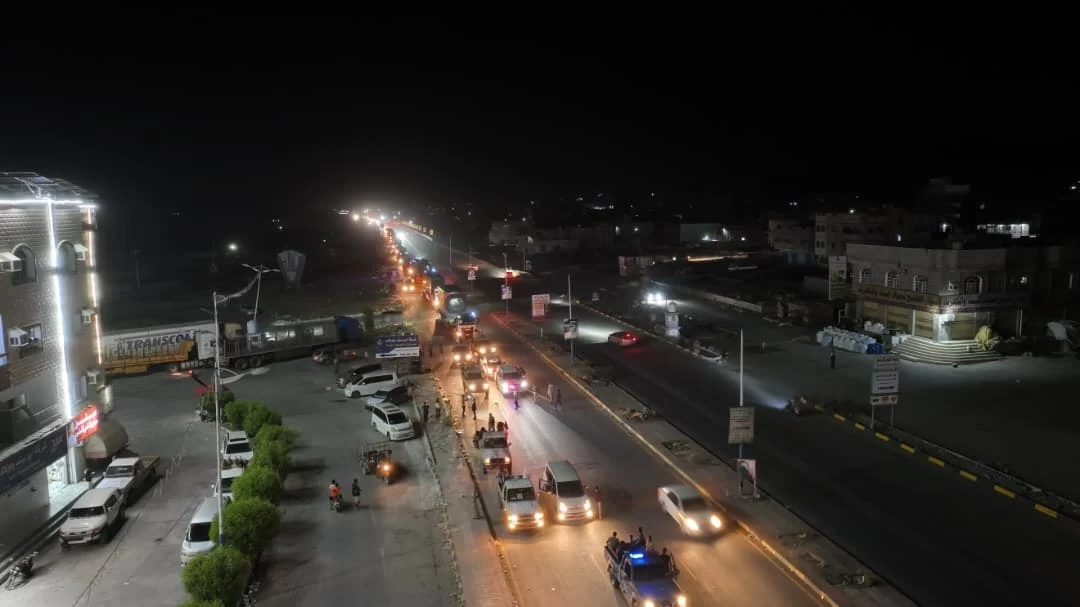
On the evening of Thursday, July 2, 2026, convoys carrying emergency electricity generators provided by the Kingdom of Saudi Arabia arrived in Al Mukalla City, amid a public reception featuring celebrations and fireworks. Their arrival is part of a project to boost electricity generation on the Hadramout coast, with a planned capacity of 100 megawatts, ahead of transporting the equipment to the power station sites, completing its installation, and connecting it to the public grid.
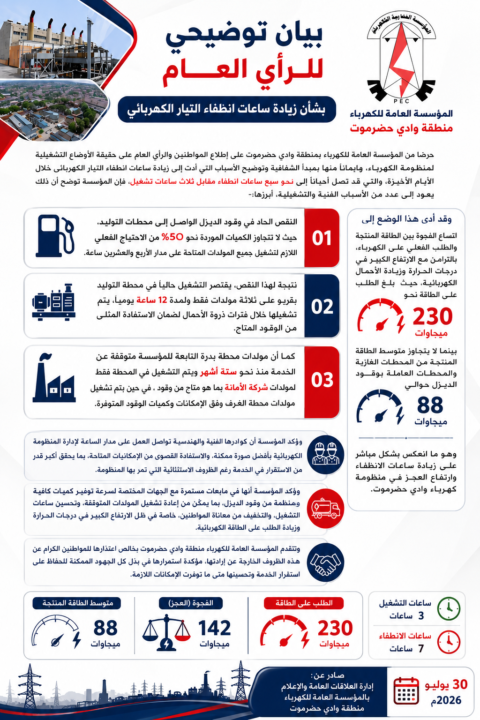
The electricity crisis in Wadi Hadramout reached severe levels in late July 2026, after the Public Electricity Corporation revealed that diesel supplies covered only about half of actual needs, forcing it to reduce generator operation amid a widespread generation deficit and an outage schedule that at some times reached seven hours without power for every three hours of operation.
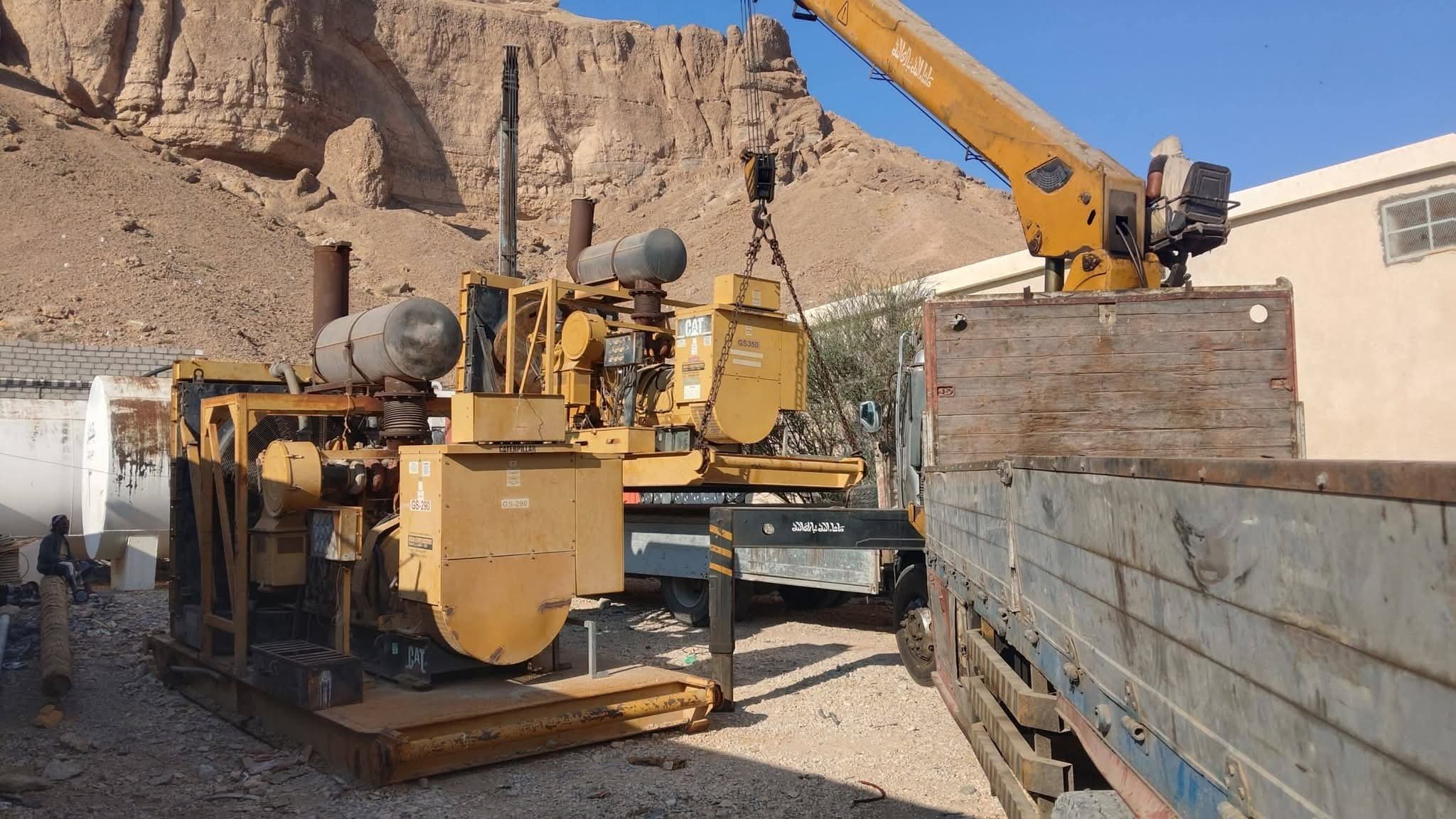
A new 800-kilowatt generator arrived in Daw'an District, Hadramout Governorate, on Thursday, November 5, 2026, in a step aimed at boosting generation capacity, improving the stability of electricity service, reducing recurring outages, and preparing for increased energy demand during the summer.