
Fuel Shortage Deepens Electricity Crisis in Wadi Hadramout: Seven Hours of Outages Against Three Hours of Operation
The electricity crisis in Wadi Hadramout reached severe levels in late July 2026, after the Public Electricity Corporation revealed that diesel supplies covered only about half of actual needs, forcing it to reduce generator operation amid a widespread generation deficit and an outage schedule that at some times reached seven hours without power for every three hours of operation.
The electricity system in Wadi Hadramout and the Desert experienced a sharp deterioration in the final days of July 2026, as the gap widened between power generation and rising electricity demand amid fuel shortages and the shutdown of several generators, leading to longer outages in areas served by the grid.
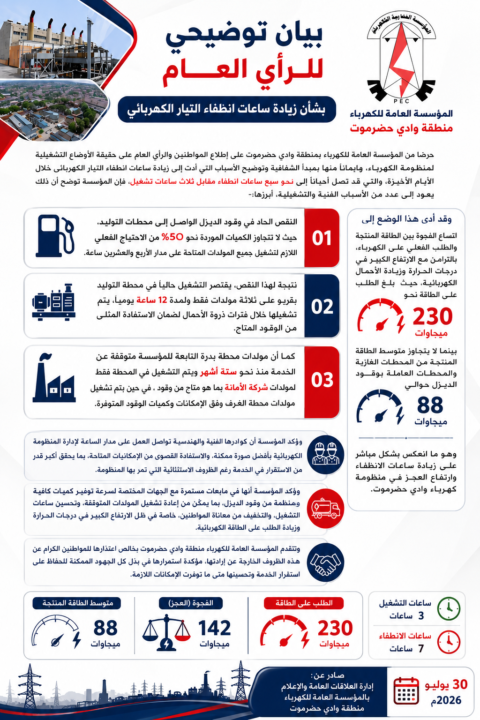
On July 30, the Public Electricity Corporation in the Wadi Hadramout region issued an official statement outlining the operational reasons behind the decline in service. It explained that the outage schedule had at times reached about seven hours without power for every three hours of operation.
The Corporation attributed the deterioration primarily to a sharp decline in the quantities of diesel reaching the power stations, noting that available supplies amounted to no more than about 50% of the quantities needed to operate all available generators around the clock.
This shortage imposed restrictions on the operation of diesel-powered stations and forced technical teams to distribute the limited quantities among generating units according to load priorities and peak hours.
At Qaryou Station, operation was limited to just three generators for 12 hours a day, instead of making use of all available units throughout the day, in an effort to direct electrical capacity to periods of higher consumption.
As for Badra Station, the Corporation disclosed that its generators had been out of service for about six months, while the Al-Amanah Company generators located at the station continued to operate according to the available fuel quantities.
At Al-Ghuraf Station, generation continued on a limited basis, in line with technical capabilities and available fuel quantities, reducing its contribution to meeting overall electricity demand.
These conditions coincided with rising temperatures and increased electricity consumption, pushing power demand to about 230 megawatts, against average production of only around 88 megawatts from gas-fired and diesel-powered stations.
Based on these approximate figures, the gap between demand and generation reached about 142 megawatts, a substantial deficit that directly affected the Corporation’s ability to provide subscribers with regular hours of operation.
Daily operational reports confirmed the scale of the crisis. On the evening of July 30, the electricity system recorded demand of 226.9 megawatts, against actual production of no more than 80.1 megawatts, leaving a deficit of 146.8 megawatts.
Evening-period data showed that the PetroMasila gas-fired station contributed 57 megawatts of production, while Al-Jazirah gas-fired station produced 8 megawatts, Qaryou Station 7.4 megawatts, Al-Ghuraf Station 2.4 megawatts, and the Al-Amanah Company generators at Badra 5.3 megawatts.
By contrast, the Corporation’s generators at Badra Station recorded zero production, consistent with the statement’s disclosure that they remained out of service.
These data indicate that most of the power generated came from gas-fired stations, led by the PetroMasila station, while the contribution of diesel-powered generators remained limited because of the supply crisis.
In response to the situation, the Corporation said it was continuing to follow up with the relevant authorities to secure sufficient and regular fuel supplies, enabling the restart of out-of-service generators, increasing production, and reducing outage hours.
It also said its technical and engineering teams continued to manage the system with the available capacity, while seeking to maintain grid stability despite the significant production shortfall.
The July 2026 crisis highlights the ongoing structural problems facing the electricity sector in Wadi Hadramout. The deficit is no longer linked only to the lack of sufficient generating stations; it also includes the inability to operate some existing capacity because of fuel shortages, alongside the prolonged shutdown of other units.
This deterioration came months after the announcement of a project to build two new emergency power stations with a capacity of 100 megawatts in Al-Ghuraf and Badra, highlighting the gap between the future capacity planned for addition and the actual generation available to residents while the projects are being implemented.
The continuing fuel crisis also showed that electricity stability requires simultaneous action to address supply, maintenance, and generation problems, and that increasing the stations’ nominal capacity will not deliver its full impact unless operating requirements are available on a regular basis.
The July 30, 2026 statement marked an important point in the chronology of the electricity crisis in Hadramout because it documented, with figures, the deficit reaching high levels and detailed the operational constraints facing Qaryou, Badra, and Al-Ghuraf stations.
The event is particularly significant in the Agency’s archive because it documents a period when outages were no longer the result of temporary faults, but a direct reflection of a wide gap between residents’ needs and available capacity, amid continued reliance on limited operational measures to address a mounting crisis.