
Sudden Malfunction in a PetroMasila Turbine Worsens Wadi Hadramout Power Deficit Amid Fuel Shortages
The electricity crisis in Wadi Hadramout worsened after one of the turbines at the PetroMasila gas-fired power station went out of service on February 6, 2026, for emergency maintenance, amid continuing shortages of diesel fuel. This increased the generation deficit and lengthened power outages, before the turbine was returned to service on the afternoon of February 9, with expectations of a gradual improvement in electricity supply.
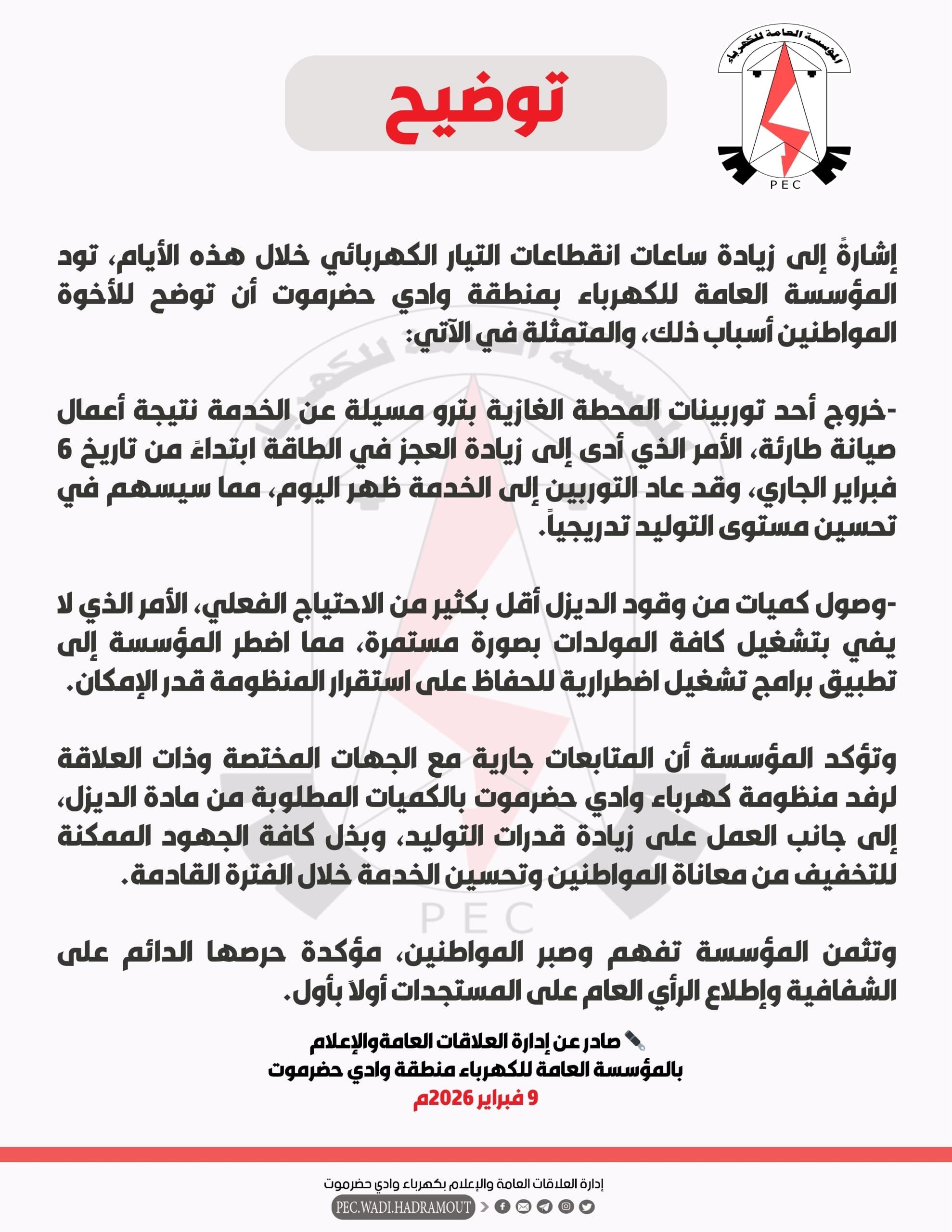
The electricity system in Wadi Hadramout and the desert experienced a new disruption to generation on Friday, February 6, 2026, after one of the turbines at the PetroMasila gas-fired power station went out of service for emergency maintenance. The development increased the power deficit and prolonged outage hours in areas connected to the grid.
The malfunction occurred as the electricity system was facing ongoing operational pressures due to irregular supplies of diesel fuel in the quantities needed to run backup generators. This limited the Public Electricity Corporation’s ability to compensate for the power lost from the gas-fired station.
Operating reports issued by the Wadi Hadramout Electricity Corporation showed the scale of the deficit on the day of the malfunction: total electricity demand during the morning period was about 155.9 megawatts, compared with actual production of no more than 69.9 megawatts, leaving a deficit of 86 megawatts.
During the evening period on the same day, demand reached 157.7 megawatts, while total production stood at 80 megawatts, resulting in a deficit of 77.7 megawatts. This reflected the continuing wide gap between consumer needs and available power.
According to operational data, the PetroMasila gas-fired station produced 43.5 megawatts during the morning period and 42 megawatts during the evening period on February 6. The remaining generating capacity was provided by Al Jazeera Gas Station, Al-Ghuraf Station and Badrah 2 Station, operated by Al Amanah Company, as well as other stations that contributed varying amounts of power.
The impact of the malfunction was not limited to a drop in the output of one generating unit; it also affected electricity distribution schedules. The corporation had to manage available capacity according to actual production levels, while taking into account the continuing shortage of diesel fuel.
On February 9, the Public Electricity Corporation in Wadi Hadramout Region announced that the out-of-service turbine had been returned to service that afternoon, following the completion of emergency maintenance. It said the turbine’s return was expected to contribute to a gradual improvement in generation levels.
However, the corporation clarified that resolving the technical malfunction did not mean the end of the outages crisis, as supplies of diesel continued to fall far short of actual operating needs, preventing all generators from running continuously.
It said it had been forced to implement exceptional operating schedules to maintain the stability of the electricity system, while continuing to coordinate with the relevant authorities to secure fuel and increase generating capacity.
Data for the evening of February 9 showed PetroMasila’s output rising to 57 megawatts, compared with 42 megawatts on the evening of February 6. Total production across the Wadi Hadramout system reached 87.9 megawatts against demand of 158.9 megawatts, leaving a deficit of 71 megawatts.
The following day, February 10, PetroMasila’s output remained at 57 megawatts during both the morning and evening periods. However, the system continued to record a deficit of 24.5 megawatts in the morning and 66.7 megawatts in the evening, confirming that the turbine’s return had improved available capacity without eliminating the overall deficit.
This development highlighted the operational importance of the PetroMasila gas-fired station within the Wadi Hadramout electricity system, as the shutdown of one of its turbines directly affected the amount of power available at a time when other stations were facing fuel-related and technical-readiness constraints.
The crisis also underscored the connection between maintenance work and the stability of electricity supplies: successfully restarting out-of-service units alone is not enough to ensure a regular power supply unless reserve capacity and the fuel needed to meet demand are available.
The February 2026 malfunction was one of the notable episodes in the history of the electricity crisis in Wadi Hadramout, combining a drop in generating capacity due to emergency maintenance with continuing fuel shortages, before technical teams succeeded in returning the turbine to service within three days.
The event’s significance in the chronological archive lies in documenting a temporary technical shutdown and a decline in production, followed by the recovery of part of the electrical capacity, while other causes of the deficit persisted. This shows that stabilizing the electricity system requires simultaneous action to address maintenance, fuel and generating-capacity problems.