
Homeland Shield launches “Taking Over the Camps” operation and takes control of the 37th Armored Brigade in Al-Khash'ah
Hadramout witnessed the launch of the “Taking Over the Camps” operation on Friday, January 2, 2026, led by Governor Salem Ahmed Al-Khanbashi and Homeland Shield forces, following a presidential decision to reorganize the military command in the governorate. The operation involved clashes with forces of the Southern Transitional Council and coalition airstrikes in the Al-Khash'ah area, ending with the announcement that control had been taken of the 37th Armored Brigade camp and that an advance toward Seiyun had begun.
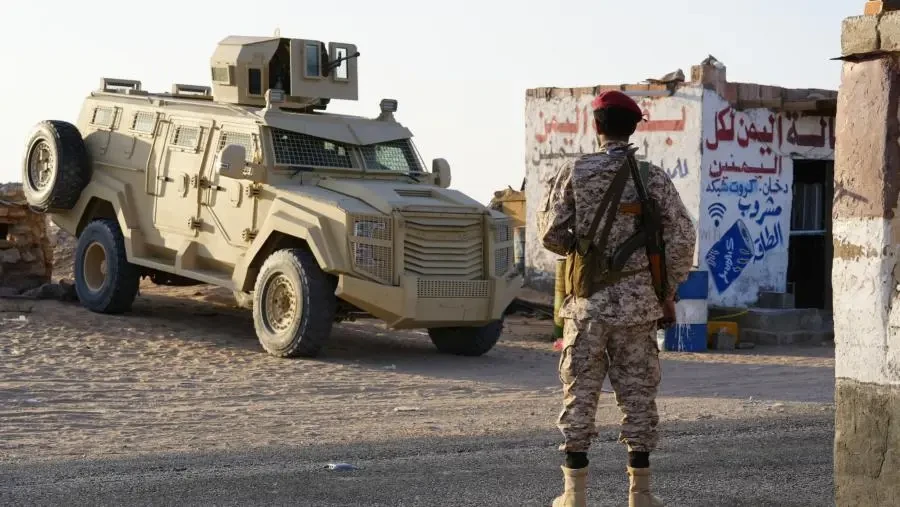
Presidential decision paves the way for the launch of the operation
Hadramout Governorate entered a new phase of military developments on Friday, January 2, 2026, following the issuance of Republican Decree No. (1) of 2026, which appointed Hadramout Governor Salem Ahmed Al-Khanbashi as commander-in-chief of Homeland Shield forces in the governorate and granted him the necessary military, security and administrative powers to restore security and stability.
The decision came after the military crisis escalated during December 2025, when forces affiliated with the Southern Transitional Council took control of Seiyun, the headquarters of the First Military Region, and a number of camps and strategic sites.
The decision was also preceded by unprecedented tensions between Saudi Arabia and the United Arab Emirates over developments in eastern Yemen, which peaked with airstrikes targeting military equipment inside Mukalla Port on December 30, 2025.
Al-Khanbashi’s appointment represented a step toward unifying the field command for the anticipated operation under the supervision of the local authority, amid presidential calls for the return of camps and military sites to forces affiliated with the Yemeni government.
Announcement of the “Taking Over the Camps” operation
Following the issuance of the decision, Governor Salem Al-Khanbashi announced the start of a military operation named “Taking Over the Camps,” explaining that its aim was to take over military sites in Hadramout in an organized manner and end the state of tension resulting from the presence of multiple armed formations.
In a televised address, Al-Khanbashi affirmed that the operation targeted only military camps and sites and did not target civilians or the governorate’s political and social components.
He called on Hadramout’s sheikhs, dignitaries and community leaders to cooperate with the relevant authorities to maintain security, protect public and private property, and prevent the situation from sliding into wider clashes.
Although the local authority affirmed that the primary goal was to hand over the camps peacefully, developments on the ground revealed armed resistance at some sites, particularly in the Al-Khash'ah area.
The 37th Brigade camp becomes the center of the clashes
The 37th Armored Brigade camp, located in the Al-Khash'ah area west of Wadi Hadramout, emerged as one of the most prominent military sites covered by the operation.
Clashes broke out around the camp between Homeland Shield forces and forces affiliated with the Southern Transitional Council, amid reports of heavy weapons being used and military vehicles moving along roads leading to the area.
The clashes coincided with airstrikes carried out by Saudi-led coalition aircraft, targeting sites and vehicles linked to the forces that confronted the advance of Homeland Shield forces, according to the government account.
Al-Khash'ah camp had particular military importance because of its strategic location on the western approaches to Wadi Hadramout and its connection to roads leading to Al-Qatn, Seiyun and desert areas.
The confrontation around the camp therefore became a decisive test of Homeland Shield forces’ ability to continue the operation and advance toward the main military and administrative centers in the valley.
Airstrikes accompany the military advance
Press reports said coalition aircraft carried out airstrikes around Al-Khash'ah as Homeland Shield forces moved toward the camp.
Anadolu Agency quoted Yemeni officials as saying the strikes came after the advancing forces were subjected to ambushes and attacks by armed groups linked to the Southern Transitional Council.
For its part, the Southern Transitional Council’s leadership had announced before the operation that it was prepared to redeploy some of its forces and involve Homeland Shield forces in security arrangements, but it had not agreed to a complete withdrawal from all the sites it had taken control of during December.
This divergence showed that the disagreement was not solely about the presence of Homeland Shield forces, but also about which party would assume command and control of the camps and military facilities.
No independent, final toll of casualties resulting from the clashes and airstrikes in Al-Khash'ah that day was available, meaning that any circulating figures require separate verification before being accepted.
Announcement of control of the 37th Brigade camp
During the day on Friday, Governor Salem Al-Khanbashi announced that Homeland Shield forces had successfully taken control of the 37th Armored Brigade camp in the Al-Khash'ah area, following clashes with forces affiliated with the Southern Transitional Council.
Media coverage reported that Transitional Council forces had withdrawn from the camp toward other areas in Wadi Hadramout, while Homeland Shield forces deployed inside and around the site.
Circulating video recordings also showed vehicles and personnel from Homeland Shield forces inside the camp after control of it was announced.
The loss of the camp by forces affiliated with the Southern Transitional Council was a significant development on the ground, as it enabled the advancing forces to strengthen their presence on the valley’s western axis and continue moving toward Seiyun.
Withdrawals and simultaneous shifts in the valley
Developments on January 2 were not limited to Al-Khash'ah camp; reports also emerged of Southern Transitional Council forces withdrawing from a number of military sites and checkpoints in Wadi Hadramout.
Other areas of the governorate also saw movements by local forces and formations linked to the Hadramout Tribes Alliance, amid rapidly shifting military deployment locations.
In Seiyun, signs began to emerge of the withdrawal of forces affiliated with the Southern Transitional Council from some sites, including the headquarters of the First Military Region, according to reports published that evening.
However, these developments did not mean that control of the city had been fully restored on January 2, as military movements continued into the following day.
Homeland Shield forces advance toward Seiyun
After announcing control of the 37th Brigade camp, Governor Al-Khanbashi disclosed that Homeland Shield forces had begun moving toward Seiyun, which was the most prominent military and administrative center in Wadi Hadramout.
The advance toward Seiyun was particularly significant because the city is home to Seiyun International Airport, the headquarters of the First Military Region, the Republican Palace, and key government and security institutions.
The movements took place amid a decline in the presence of forces affiliated with the Southern Transitional Council at a number of sites and increasing prospects that control of the city would change hands in the following hours.
On Saturday, January 3, 2026, Homeland Shield forces announced that they had regained control of Seiyun, its international airport and its main facilities. This development constitutes event No. (13) in the chronology of this file.
The military and political significance of the event
The “Taking Over the Camps” operation marked a pivotal shift in the course of the Hadramout crisis, as efforts to restore control of military sites moved from mediation and warnings to a broad field operation.
The clashes in Al-Khash'ah showed that reorganizing military deployments was not merely an administrative measure, but was linked to a shift in the balance of power and the use of air support at some sites.
Control of the 37th Brigade camp also helped open the way for Homeland Shield forces to advance toward Seiyun and paved the way for the military developments seen in the valley and coastal cities in the following days.
Accordingly, January 2, 2026, is recorded as the start of the military operation that changed the balance of control in Hadramout and as the direct prelude to the recapture of Seiyun the following day.