
Coalition Airstrikes on Mukalla Port Spark Unprecedented Military Crisis Between Saudi Arabia and the UAE
The Saudi-led coalition carried out an airstrike early on Tuesday, December 30, 2025, targeting military vehicles and equipment at Mukalla Port. It said they had arrived aboard two ships from Fujairah Port to support forces of the Southern Transitional Council. The UAE denied transporting weapons to any Yemeni party, saying the vehicles were intended for its own forces. The strike ignited a political and military crisis, followed by exceptional presidential decisions in Yemen.
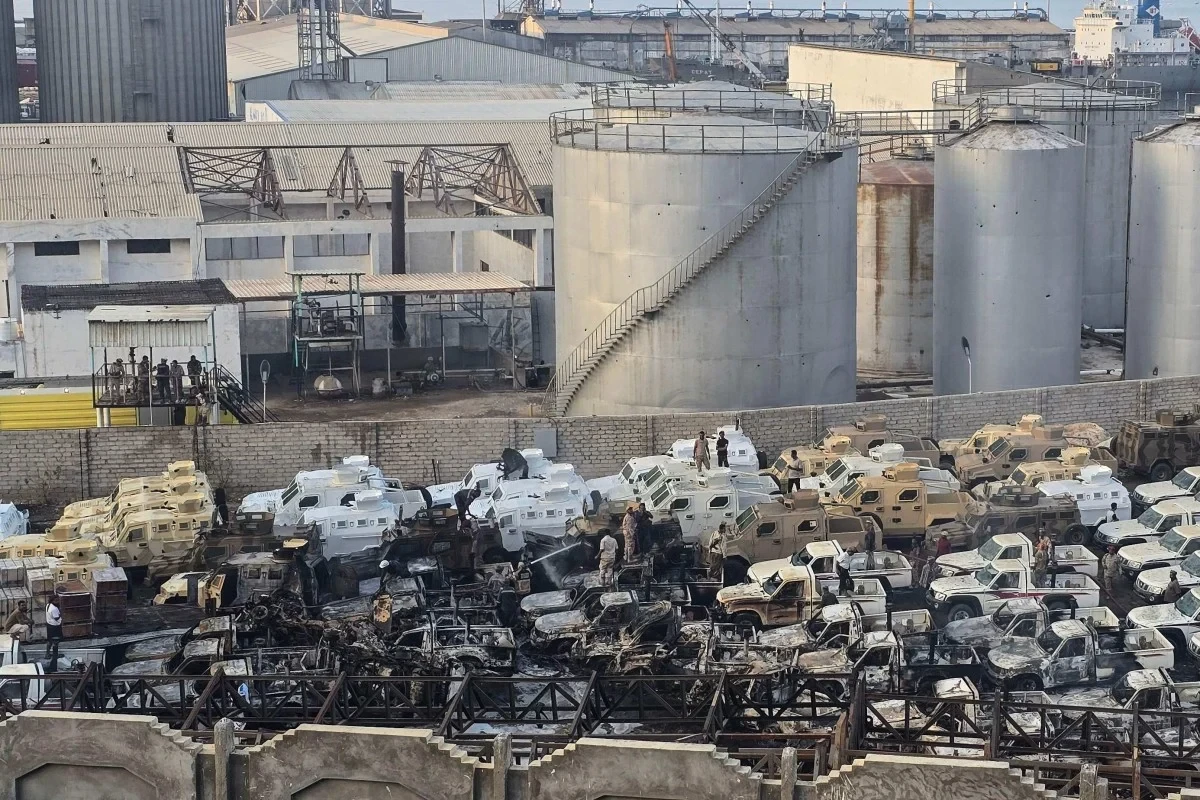
The city of Mukalla, the capital of Hadramout Governorate, witnessed one of the most significant military and political developments in the crisis that swept the governorate during the month early on Tuesday, December 30, 2025, after coalition aircraft led by Saudi Arabia carried out an airstrike targeting military equipment inside Mukalla Port.
The operation came amid escalating disputes over the control of strategic sites in Hadramout and Al Mahrah by forces affiliated with the Southern Transitional Council, and days after Saudi Arabia called for those forces to withdraw and for the camps to be returned to security arrangements overseen by the Yemeni government and the Homeland Shield Forces.
The repercussions of the airstrikes did not stop at the port, but extended to Saudi-Emirati relations, decisions by Yemen’s Presidential Leadership Council, and the future of the UAE’s military presence in Yemen.
Two ships arrive at Mukalla Port
According to an official statement issued by the Joint Forces Command of the Coalition, two ships arrived at Mukalla Port on December 27 and 28, 2025, from the UAE’s Fujairah Port.
The coalition’s spokesman, Major General Turki Al-Maliki, said the two ships entered the port without obtaining the necessary permits and that their crews disabled their tracking and identification systems.
The coalition accused the ships of unloading weapons and combat vehicles to support forces affiliated with the Southern Transitional Council in Hadramout and Al Mahrah, considering this an escalation that threatens de-escalation efforts.
The statement stressed that bringing in military support in this manner violates the applicable procedures and United Nations Security Council Resolution 2216, according to the coalition command’s interpretation.
However, these details about the cargo’s contents and its intended recipient were part of the coalition’s official account and later became the subject of a direct dispute with the UAE.
Airstrike carried out
On the morning of December 30, the coalition command announced that it had carried out what it described as a limited air operation, targeting weapons and combat vehicles that it said had been unloaded from the two ships inside Mukalla Port.
Al-Maliki explained that the operation came in response to a request from Yemeni Presidential Leadership Council Chairman Rashad al-Alimi to take military measures to protect civilians and prevent the escalation from spreading in the eastern governorates.
The coalition affirmed that the strike was carried out after the cargo had been monitored and documented, and that measures had been taken to avoid casualties or damage to civilian facilities.
Video footage circulated by media outlets showed military vehicles burning and damaged in the port area.
By contrast, no independently confirmed casualty figures from the airstrike were available, and no impartial investigation findings were announced to settle all the details concerning the targeted cargo.
Coalition reveals further details about the cargo
In subsequent clarifications, the coalition spokesman said the two ships were carrying more than 80 military vehicles, in addition to containers containing weapons and ammunition.
He added that the coalition had informed Emirati officials of the need to prevent the equipment from leaving the port, before some of the vehicles and containers were moved to Al Rayyan Air Base, according to his account.
Al-Maliki explained that the vehicles were later returned to the port, while containers that he said contained weapons remained inside Al Rayyan Base.
The coalition justified its decision to carry out the strike by saying it had information that the equipment might be moved to military sites in the valleys and desert areas of Hadramout, potentially leading to further escalation.
This information remains the coalition’s official account, not the findings of an independent investigation, particularly as the UAE offered a different explanation of the cargo’s nature and the communications that preceded its targeting.
UAE denies transporting weapons to Yemeni forces
On the same day, the UAE Ministry of Foreign Affairs issued a statement rejecting accusations of fueling the conflict in Yemen and affirming that the cargo that arrived at Mukalla Port did not include weapons.
It explained that the vehicles unloaded were intended for use by Emirati forces operating in Yemen, and not to arm the Southern Transitional Council or any other Yemeni party.
It also said that high-level coordination had taken place with Saudi Arabia regarding the vehicles, and that there had been an understanding that they would not leave the port.
The UAE expressed surprise that the equipment had been targeted despite this coordination, and rejected the accusation that it had directed Yemeni parties to carry out military operations threatening Saudi Arabia’s security or borders.
Abu Dhabi affirmed that its role in Hadramout and Al Mahrah had been aimed, according to its position, at containing the crisis and supporting de-escalation efforts.
Thus, the cargo’s nature and route, as well as the communications preceding the airstrike, became the focus of an openly declared official dispute between Riyadh and Abu Dhabi, with no published independent investigation settling the two accounts.
Exceptional presidential decisions in Yemen
The airstrikes coincided with the issuance of important decisions by Presidential Leadership Council Chairman Rashad al-Alimi, most notably the declaration of a state of emergency throughout Yemen for 90 days, subject to extension.
The declaration also instructed all forces and military formations in Hadramout and Al Mahrah to return to their primary positions, coordinate with the coalition command, and hand over the sites to the Homeland Shield Forces.
The decisions included granting the governors of Hadramout and Al Mahrah broad powers to administer the affairs of their governorates, and imposing an air, sea and land blockade on the border crossings for 72 hours, except in cases authorized by the coalition.
Al-Alimi also announced the cancellation of the joint defense agreement with the UAE and called for its forces to leave Yemen.
These decisions received support from parties within the National Defense Council, but drew objections from other members of the Presidential Leadership Council, reflecting the continuing political division over the management of the crisis.
UAE announces withdrawal of its remaining forces
After the crisis escalated, the UAE Ministry of Defense announced its intention to end the presence of its remaining forces in Yemen.
It linked the move to recent developments and their potential impact on the safety and effectiveness of counterterrorism missions that it said its forces had been carrying out.
The announcement marked a further development in the crisis, as the dispute was no longer limited to a military shipment or an airstrike, but extended to the future of Emirati military cooperation in Yemen.
Nevertheless, the announcement of a withdrawal does not by itself establish that all personnel had completed their departure or that all forms of military influence linked to the UAE had ended on December 30.
Position of the local authority in Hadramout
The local authority in Hadramout Governorate, headed by Governor Salem al-Khanbashi, announced its support for the decisions issued by the Presidential Leadership Council chairman.
It affirmed its readiness to coordinate with the Homeland Shield Forces to take over the camps and vital sites, and to ensure the transfer of military and security responsibilities.
This position came as the governorate was experiencing military polarization, following changes in control of Seiyun and the oil facilities, and a rise in the level of troop deployments in the desert areas.
The local authority’s support reflected a move toward reorganizing the military deployment in accordance with the presidential decisions and Saudi support, while actual implementation remained dependent on developments on the ground.
Military and political significance of the event
The airstrikes on Mukalla Port marked a highly significant turning point in the Hadramout crisis for three main reasons.
First, they brought the escalation to a strategic commercial port in the governorate’s capital, after the most prominent previous confrontations had been concentrated in camps and oil-producing and tribal areas.
Second, they exposed a sharp public disagreement between Saudi Arabia and the UAE over military moves in eastern Yemen, despite their previous participation in the coalition supporting the Yemeni government.
Third, the airstrikes were linked to broad presidential decisions that included a state of emergency, arrangements for handing over the camps, cancellation of the defense agreement with the UAE, and a call for its forces to withdraw.
These developments became a direct prelude to a new phase of confrontation and a reshaping of military control in Hadramout during the first days of January 2026.
December 30, 2025, is thus recorded as one of the most pivotal days in the history of modern security and military shifts in Hadramout, as the crisis transformed from a struggle over deployment sites and influence into an open regional confrontation with broad military and political repercussions.