
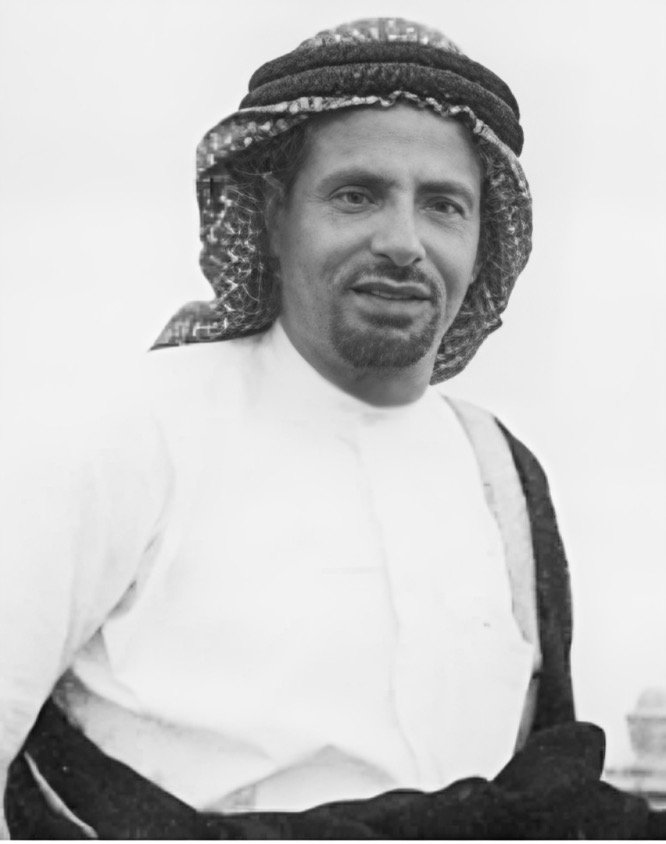
Mohammed Awad bin Laden
Businessman Born: 1908, Ribaat Ba'ashan – Wadi Daw'an – Hadramout Died: 3 September 1967 Daw'an
Mohammed Awad bin Laden, a businessman and contractor of Hadrami origin, was born in 1908 in the Al-Ribat area of Wadi Daw'an in Hadramout Governorate. He is considered one of the figures associated with the history of Hadrami migration to Saudi Arabia and the development of its contracting and construction sector during the twentieth century. In his youth, he moved to Saudi Arabia in search of work opportunities. He began his career in simple jobs before entering the construction and contracting sector and establishing a business that later developed into Saudi Binladin Group, one of the well-known companies in the construction sector. He died in 1967 in a plane crash in Saudi Arabia.
Biography
Birth and Early Life
Sheikh Mohammed bin Awad bin Laden was born in the village of Ribaat Ba'ashan in Wadi Daw'an, Hadramout Governorate. His birth is believed to have been in 1908, although some sources give the year as 1907.
He grew up in a low-income family and had no opportunity to attend formal school. He began working at an early age and gained experience through hands-on work in manual labor and construction.
Migration to Saudi Arabia
He left Hadramout in his youth in search of economic opportunities and arrived in the city of Jeddah in 1930, at a time when Saudi Arabia was undergoing the beginnings of urban and economic change.
At the start of his stay, he worked in simple jobs, including at a restaurant and carrying goods at the Port of Jeddah, before moving into construction, which became the foundation of his subsequent business activity.
Beginnings in the Contracting Sector
Mohammed bin Laden turned to construction work in the early 1930s and drew on his practical experience to carry out small projects.
He began establishing his own contracting business, and his work gradually expanded as he secured contracts to construct government buildings and facilities.
He was known by the title “Al-Muallim,” a title given to people with practical experience in the construction trades.
Expansion into Government Projects
The year 1934 marked an important stage in his career, when he began carrying out major government projects during the reign of King Abdulaziz Al Saud, including the construction of palaces and official buildings.
As his business expanded, the company he had founded became one of the prominent firms in the Kingdom's contracting sector.
In the mid-1950s, he assumed responsibilities related to overseeing government building and construction works, according to the book “Al-Muallim,” which documented his life.
Projects at the Two Holy Mosques
Mohammed bin Laden's name became associated with expansion and development projects at the Prophet's Mosque in Medina and the Grand Mosque in Mecca.
His construction business took part in carrying out the first Saudi expansion of the Prophet's Mosque, which began during the reign of King Abdulaziz and continued during the reign of King Saud.
He was also assigned work as part of the expansion of the Grand Mosque, during a period of extensive urban projects to serve worshippers, pilgrims, and Umrah performers.
Work in Jerusalem
His activities extended to the city of Jerusalem, where his name was associated with restoration work and the re-covering of the Dome of the Rock at Al-Aqsa Mosque during the 1960s.
These works are among the most prominent religious and historic projects mentioned in sources documenting his projects outside Saudi Arabia.
Road and Infrastructure Projects
He took part in carrying out road and public-facility projects, the best known of which was work on the Al-Hada Road linking Mecca and Taif.
His company also carried out works related to Aramco facilities in the Eastern Province, in addition to other government construction projects.
Establishment of Saudi Binladin Group
Mohammed bin Laden established a contracting business that later developed into Saudi Binladin Group, which continued to operate and expand after his death.
In the following decades, the group became a well-known name in the construction and infrastructure sector and was associated with carrying out major government and urban development projects.
Death
Sheikh Mohammed Awad bin Laden died in 1967 in a helicopter crash while inspecting one of his projects in Saudi Arabia.
Several references state that the accident occurred on September 3, 1967, while some accounts differ over its precise location.
His body was taken to Mecca, where he was buried in Al-Ma'ala Cemetery, according to the documentary book “Al-Muallim.”
The business he founded continued after his death, becoming part of the history of the contracting sector in Saudi Arabia.
Works
1. Establishment of the Saudi Binladin Group business He established a company specializing in contracting and construction during the 1930s, which later developed into Saudi Binladin Group and continued operating after his death. 2. Participation in the expansion of the Prophet's Mosque He carried out construction work as part of the first Saudi expansion of the Prophet's Mosque in Medina, which began during the reign of King Abdulaziz Al Saud. 3. Participation in the expansion of the Grand Mosque His name was associated with expansion works at the Grand Mosque in Mecca during the 1950s and 1960s. 4. Work on the Dome of the Rock in Jerusalem He took part in restoration and re-covering work on the Dome of the Rock at Al-Aqsa Mosque during the 1960s. 5. Carrying out government projects He undertook the construction of government buildings, palaces, and facilities in Saudi Arabia, and these projects contributed to the expansion of his business. 6. Work on Al-Hada Road His company was associated with carrying out work on Al-Hada Road, which links Mecca and Taif, as part of infrastructure projects. 7. Carrying out projects related to Aramco His company carried out construction work for Aramco in Saudi Arabia's Eastern Province. 8. Assuming responsibilities in government construction His biography states that he was appointed director general of government buildings and construction during the reign of King Saud, in the mid-1950s. 9. Building a business that continued after his death He laid the institutional foundations for a contracting business that continued to operate and expand in the following decades, carrying out urban development projects inside and outside the Kingdom. 10. A place in the history of Hadrami migration His career represents one of the notable experiences of Hadrami migrants who moved from Hadramout to the Arabian Peninsula and established businesses in their countries of migration.