
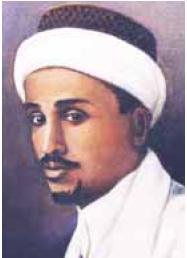
Muhammad bin Hashim
Educator Born: 1883, Tarim – Hadramout Died: 1960 Tarim
Muhammad bin Hashim, a Hadrami writer and educational reformer, was associated with the cultural and educational movement in the city of Seiyun during the first half of the twentieth century. He contributed to the development of education and the spread of knowledge, and was among those who called for social and educational reform. He left a significant mark on Hadramout’s intellectual life.
Biography
Birth and Early Life
Muhammad bin Hashim bin Tahir al-Alawi was born in 1300 AH, corresponding to around 1883 AD, in the village of Masilah Al Sheikh, near the city of Tarim in Wadi Hadramout.
He grew up in a scholarly environment and received his education in Masilah, Tarim, and Seiyun from a number of scholars of his time, including Abdullah bin Umar al-Shatiri, Hasan bin Alawi bin Shihab, and Muhammad bin Uthman bin Yahya.
This period helped shape his interest in knowledge and literature, before he turned to advocating the development of teaching methods and curricula.
His Journey to Indonesia
He left Hadramout in 1907 AD for the island of Java in Indonesia, one of the most prominent centers of Hadrami migration.
He worked in trade for a short time, then moved on to teaching and school administration. He began at Al-Munawwar School in Palembang, before working at other educational institutions in Jakarta, Pekalongan, and Surabaya.
He sought to modernize curricula by introducing subjects such as natural sciences, composition, public speaking, and English, alongside religious sciences and Arabic.
His ideas sparked debates and disagreements with some conservative currents that opposed changing traditional teaching methods.
His Role in the Hadrami Press
Muhammad bin Hashim’s activities were not limited to education; they also extended to journalism and authorship.
He wrote for a number of Arabic newspapers and magazines published in Southeast Asia and Egypt, and took part in editing and managing publications that addressed education, reform, and the circumstances of Hadrami migrants.
Among the newspapers associated with his name were “Al-Bashir,” “Al-Mizan,” “Al-Iqbal,” and “Hadramout,” which led him to be known in historical studies by the title “Sheikh of the Hadrami Press.”
Return to Hadramout
He returned to Hadramout in the 1920s and took over the administration of Jam'iyat al-Haqq School in the city of Tarim, where he continued his efforts to develop school curricula.
He advocated teaching arithmetic, natural sciences, and astronomy, and encouraging school activities, including journalism, public speaking, and sports.
He also took part in Tarim’s cultural life and delivered lectures addressing social issues, education, and reform.
His Activities in Seiyun
A period of his life was associated with the city of Seiyun, where he held administrative responsibilities during the era of the Kathiri State and took part in work related to historical and judicial affairs.
He later focused on education at the Sultan’s School in Seiyun, continuing his intellectual and educational activities.
It is important to distinguish between his role in developing education and the founding of Al-Nahdah Scientific School in Seiyun; the school’s recognized founder was the scholar Saqqaf bin Muhammad al-Saqqaf, not Muhammad bin Hashim.
Death and Legacy
Muhammad bin Hashim died in the city of Tarim during the month of Safar in 1380 AH, corresponding to 1960 AD, and was buried in Zanbal Cemetery.
He left a collection of historical and literary works, as well as articles and lectures addressing education, reform, and the conditions of Hadramout and its migrants.
Works
1. Developing education in Indonesia: He introduced modern educational subjects and methods to a number of schools serving the Hadrami community. 2. Founding and managing schools: He took part in founding and managing educational institutions in various Indonesian cities. 3. Journalism pioneer: He contributed to publishing and editing Arabic newspapers that addressed issues facing Hadramis abroad. 4. Modernizing curricula in Tarim: He worked to expand school subjects to include modern sciences and cultural activities. 5. Encouraging academic missions: He headed an educational mission of students from Indonesia to Egypt during the 1920s. 6. Historical authorship: He documented aspects of the history of the Kathiri State and Hadramout. 7. Cultural activity: He delivered lectures and wrote articles calling for reform and renewal. 8. Documenting economic life: In his works, he addressed the history of the Al-Kaf family and its economic and social role.