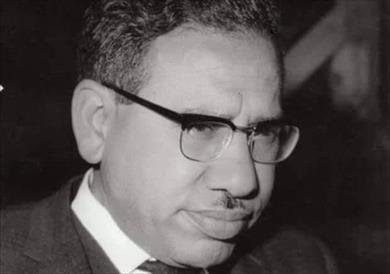
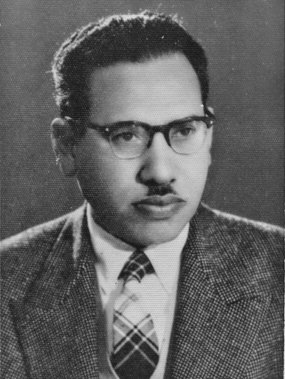
Ali Ahmad Bakathir
Writer Born: 21 December 1910, Surabaya – Indonesia Died: 10 November 1969 Sayun
Ali Ahmad Bakathir, a writer, novelist and playwright of Hadrami origin, was born in Indonesia in 1910 and grew up in the city of Seiyun in Wadi Hadramout. He is considered one of the pioneers of modern Arabic literature and was known for his historical novels and plays, foremost among them the novel “Wa Islamah” and the play “Akhnaton and Nefertiti.” He contributed to the development of Arabic verse drama and left a substantial literary legacy before his death in Cairo in 1969.
Biography
Birth and Upbringing
Ali bin Ahmed bin Mohammed Bakathir Al-Kindi was born on December 21, 1910, in the Indonesian city of Surabaya, to a Hadrami family whose roots trace back to Wadi Hadramout.
He moved to the city of Seiyun during his childhood, where he grew up in a scholarly and literary environment. He received his education at the Scientific Renaissance School and studied Arabic linguistics, jurisprudence and Islamic law under a number of the city’s scholars.
Education and the Beginnings of His Literary Career
His poetic talent emerged at an early age. He began writing poetry when he was thirteen, then taught at the Scientific Renaissance School and became its head before turning twenty.
He was influenced by the cultural life of Seiyun and its gatherings of scholars and writers, which later shaped his interest in Arab and Islamic history and heritage.
Leaving Hadramout and Moving to Egypt
Bakathir left Hadramout in the early 1930s, following the death of his first wife, and traveled through Aden and the Hijaz before arriving in Egypt in 1934.
He enrolled in the Faculty of Arts at Fuad I University, now known as Cairo University, where he specialized in English. He earned his bachelor’s degree in 1939, followed by a diploma in education in 1940.
Literary and Professional Career
He worked as an English teacher in Egypt for several years, then moved to work at the Ministry of Culture and National Guidance.
During his stay in Cairo, he built relationships with a number of writers and intellectuals, including Abbas Mahmoud Al-Aqqad, Tawfiq Al-Hakim and Naguib Mahfouz.
He devoted a large part of his life to writing novels and plays, drawing inspiration from Arab and Islamic history as well as social and political issues.
Contributions to Arabic Drama
Bakathir was one of the pioneers of innovation in Arabic verse drama and contributed to the use of blank verse and free verse in playwriting.
Among his most notable experiments were his translation of Shakespeare’s “Romeo and Juliet” into Arabic in blank verse, and his play “Akhnaton and Nefertiti,” considered one of the early works to develop the poetic structure of Arabic drama.
Novels
Bakathir was known for his historical novels, foremost among them “Wa Islamah,” which dealt with a period in Islamic history and the conflict with the Mongols.
He also wrote the novel “The Red Rebel” and other works that combined literary storytelling with the depiction of historical figures and events.
Death and Literary Legacy
Ali Ahmad Bakathir died in Cairo on November 10, 1969, at the age of 58.
He left dozens of novels, plays and poetic works. His writings have become the subject of academic and critical studies examining his contribution to the development of modern Arabic literature and drama.
Works
1. Writing the novel “Wa Islamah” He wrote one of the best-known Arab historical novels, which dealt with a period of resistance to the Mongol invasion and was later adapted into a film. 2. Pioneering the development of verse drama He contributed to innovation in drama through the use of blank verse and free verse. His most notable work in this field was “Akhnaton and Nefertiti.” 3. Writing the epic about Umar ibn al-Khattab He completed an extensive historical play about Caliph Umar ibn al-Khattab, consisting of nineteen parts. 4. Enriching the historical novel He produced a number of novels about events and figures from Arab and Islamic history, including “The Red Rebel.” 5. Writing a range of plays He wrote historical, social and political plays, including “The Secret of the Ruler by God’s Command,” “The Secret of Shahrazad” and “The Tragedy of Oedipus.” 6. Translating world literature He translated William Shakespeare’s play “Romeo and Juliet” into Arabic, using blank verse. 7. Contributing to education and culture He worked as a teacher in Hadramout and Egypt, then at the Egyptian Ministry of Culture, combining educational work with literary production. 8. Receiving literary awards He received Egypt’s State Appreciation Award for Literature in recognition of his contributions to the novel and drama. 9. The presence of his works in film and television Some of his works were adapted for film and television, most notably “Wa Islamah,” broadening the reach of his literary output.
Photos