
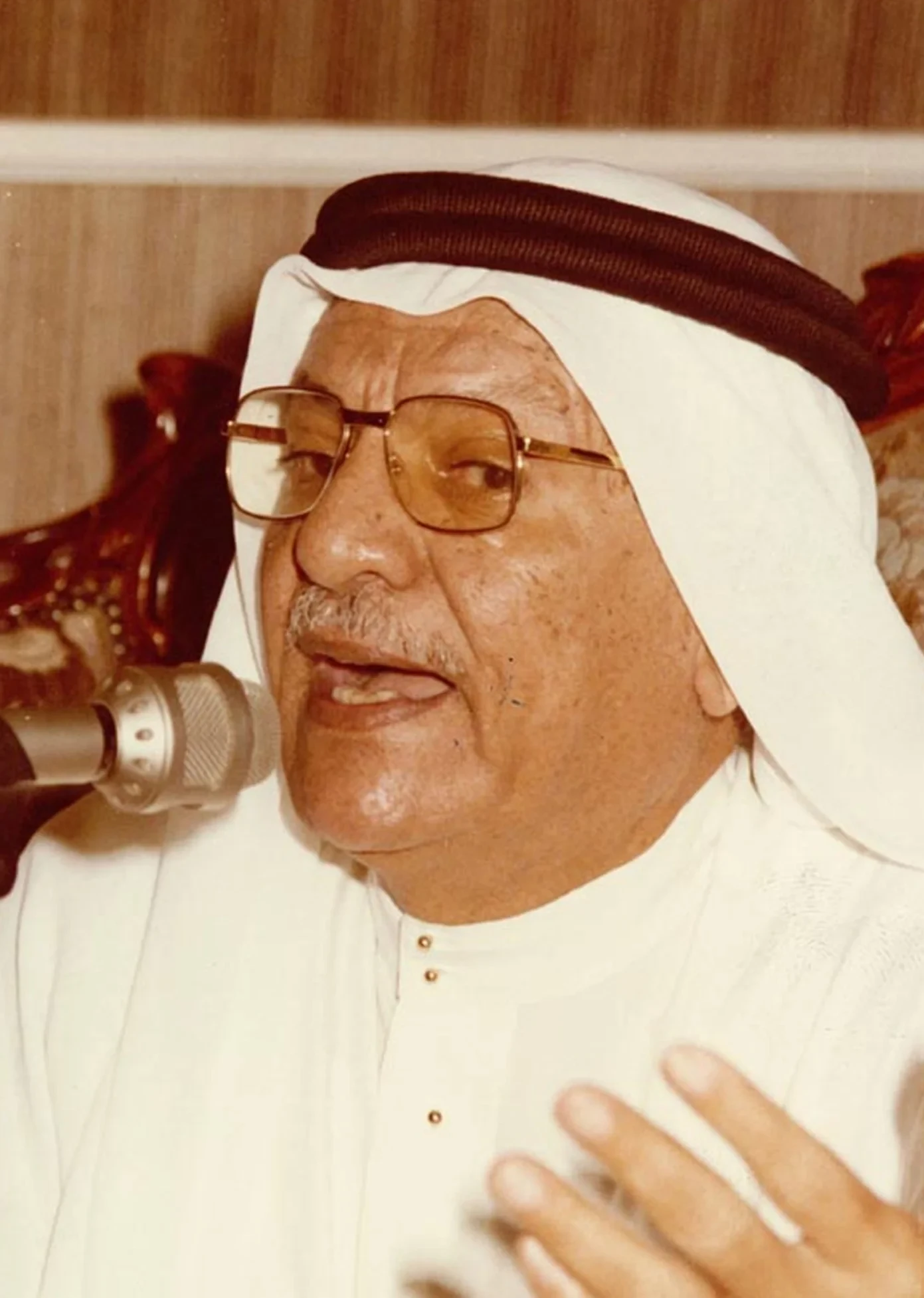
Abdullah bin Omar Belkhair
Poet Born: 1915, Daw'an District Died: 8 December 2002 Daw'an
Abdullah Omar Belkhair was a poet, writer, and media figure born in Ghayl Belkhair in Daw'an District, Hadramout Governorate. He migrated to Mecca as a child and later studied at the American University of Beirut, before holding important positions in the Saudi Royal Court. He worked as a translator for King Abdulaziz Al Saud and helped establish the General Directorate of Radio, Press and Publishing, then served as Minister of State for Information Affairs in 1961. He also left behind poetic, literary, and historical works, and remained one of the leading pioneers of Saudi media until his death in 2002.
Biography
Birth and upbringing in Hadramout
Abdullah bin Omar Belkhair was born in the village of Ghayl Belkhair in Wadi Daw'an, Hadramout Governorate, during the early years of the twentieth century. Sources differ on his year of birth: some give 1902, others 1912, while the Saudipedia encyclopedia uses 1915.
He grew up in a Hadrami family that valued education and literature, and learned the basics of reading, writing, arithmetic, and Arabic calligraphy in the traditional village schools.
From childhood, he showed a clear inclination toward poetry, influenced by the folk poems and zawamil he heard at social occasions. He began memorizing and reciting them before turning to composing poetry in classical Arabic.
Migration from Daw'an to Mecca
Belkhair moved with his father from Hadramout to the Hijaz at an early age, and the family settled in the Shubaykah neighborhood of Mecca.
This migration marked an important turning point in his life, as it gave him the opportunity to attend formal schools and encounter a different cultural environment that brought together religious studies, literary activity, and journalism.
He enrolled at the National School, then continued his studies at Al-Falah School in Mecca, one of the well-known educational institutions in the Hijaz.
During this period, he took an interest in the Arabic language, religious sciences, and literature, while continuing to develop his poetic talent through reading and participation in school activities.
His beginnings in poetry and literature
Abdullah Belkhair's poetic talent became notably apparent during his school years in Mecca.
One of his early milestones was taking part with a welcoming poem on the occasion of a visit by a delegation of Iraqi scouts, in which he expressed his affiliation with the Arabian Peninsula and the cultural ties extending across its countries.
The poem attracted attention in educational and literary circles and helped make his talent known.
He also wrote a collection of anthems, some of which were used in Saudi schools, and gained early recognition among those interested in poetry, earning him the title “Poet of the Youth.”
At that stage, his poetry was distinguished by its focus on Arab and Islamic issues and its expression of history and cultural identity, alongside national themes.
Studies at the American University of Beirut
Abdullah Belkhair was selected for a scholarship to Lebanon and enrolled at the American University of Beirut in 1936.
He spent about five years studying there, a period that helped develop his knowledge of English and broaden his exposure to literature, thought, and politics.
At the time, Beirut was one of the leading Arab cultural and journalistic centers, giving him the opportunity to connect with writers and literary figures from various countries.
This cultural exposure influenced his literary experience, while his command of English later helped him work in translation and political affairs.
The beginning of his career
After returning from Beirut, Abdullah Belkhair began his career at the Saudi Ministry of Finance.
He then moved to the Political Section at the Diwan of King Abdulaziz Al Saud and worked in the monitoring and translation department, which followed foreign radio broadcasts and international news.
His duties included translating media materials and reports on global political developments and preparing information for government bodies.
As his experience grew, he became a prominent figure in translation and political communication and began taking part in more important official assignments.
His work as a translator for King Abdulaziz
Abdullah Belkhair emerged as one of the translators whom King Abdulaziz Al Saud relied on during meetings with foreign figures and delegations.
He took part in translation work during a number of important diplomatic meetings in the 1940s, including the historic meetings between King Abdulaziz, U.S. President Franklin Roosevelt, and British Prime Minister Winston Churchill.
His command of English and knowledge of political affairs helped expand his responsibilities within the Royal Court.
He also headed the Office of Arab League Affairs and International Conferences and took part in organizing and following up on some activities related to Saudi foreign relations.
His work with King Saud and official delegations
Abdullah Belkhair continued his government work during the reign of King Saud bin Abdulaziz and held a number of responsibilities in the Royal Court.
He also accompanied Saudi officials on overseas visits and took part in translation and communication with foreign entities.
One notable episode in his career was his participation in King Saud's visit to India in 1955, where he held a press conference addressing international relations and Saudi foreign policy.
These assignments built on his experience in translation, media, and diplomatic affairs.
Establishing the General Directorate of Radio, Press and Publishing
Abdullah Belkhair's contribution to building Saudi media institutions is considered one of the most prominent milestones in his professional life.
In 1954, he was tasked with establishing the General Directorate of Radio, Press and Publishing and took charge of overseeing it.
The directorate was established at a time when Saudi Arabia was seeing an expansion in press and radio activity and there was a need to organize media work within a specialized government institution.
Belkhair worked to develop media administration, attract talent, and strengthen radio and press activity.
During the period he oversaw the directorate, press and media institutions expanded, alongside the development of radio services.
Appointment as Minister of State for Information Affairs
In 1961, a decision was issued appointing Abdullah Belkhair Minister of State for Radio, Press and Publishing.
The position was one of the most prominent government media posts in Saudi Arabia before the Ministry of Information was later established as an institution.
Belkhair thus became one of the figures who directly contributed to establishing and developing the first structures of Saudi media administration.
During this period, he brought together political experience, administrative work, and knowledge of language and media.
His ties to Hadramout
Although he moved to the Hijaz as a child, Abdullah Belkhair's connection to Hadramout remained evident in his biography and poetry.
Hadramout is mentioned in some of his poems, in which he expressed his connection to the history of the Arabian Peninsula and the breadth of its cultural ties.
He also maintained ties with a number of Hadrami figures living in Saudi Arabia.
Saudi newspapers report that, at the direction of King Saud, he took part in welcoming Sultan Hussein bin Omar Al Kathiri, Sultan of the Kathiri State in Hadramout, during his visit to Jeddah in 1955.
This episode reflects the continued social and official ties between Hadrami figures in the diaspora and their homeland.
His poetic and literary work
Abdullah Belkhair's activities were not limited to government work; poetry and literature remained an essential part of his life.
He was known for poems with historical and nationalist themes, particularly works addressing Arab and Islamic civilization and major events in history.
His most prominent works include poetic epics addressing subjects from Islamic and Andalusian history, using a style based on poetic narrative and evoking figures and events.
He also co-authored the book “Wahy al-Sahra,” considered one of the early works introducing modern literature in the Hijaz.
He wrote memoirs covering part of his experience with King Abdulaziz, as well as other poetic works.
In cultural circles, he was known by titles including “Poet of the Nation,” owing to his interest in Arab and Islamic issues.
His final years
After his government service ended, Abdullah Belkhair devoted more of his time to reading, travel, and writing.
He spent periods in several Arab countries, particularly Lebanon and Egypt, and continued to pursue his interests in poetry, memoirs, and historical subjects.
He maintained his relationships with writers and intellectuals, and researchers in the history of Saudi media and modern Arabic literature continued to take an interest in his experience.
Death and cultural legacy
Abdullah Omar Belkhair died in Beirut on Sunday, December 8, 2002, while receiving treatment at a Lebanese hospital.
He was buried in Lebanon, according to press sources that covered his life after his death.
He left a legacy combining government service, media, translation, and literature, and his name became associated with the period when modern Saudi media institutions were established.
In January 2009, the King Abdulaziz Foundation announced that it had received Belkhair's library and personal papers from his family, with the aim of preserving them and making them available as historical and research sources.
His experience represents one of the notable examples of Hadrami migrants who moved from their villages to important political and cultural centers and contributed to the development of modern institutions in their countries of migration.
Works
1. Contributing to the establishment of modern Saudi media: He oversaw the establishment of the General Directorate of Radio, Press and Publishing in 1954. 2. Serving as Minister of State for Radio, Press and Publishing: He was appointed to the position in 1961. 3. Working as a translator for King Abdulaziz: He took part in translation during diplomatic meetings with foreign leaders and delegations. 4. Working in the Royal Court: He held administrative and political responsibilities, including following up on Arab League affairs and international conferences. 5. Contributing to the development of radio and press work: He took part in organizing media institutions and expanding their activities. 6. Writing poetic epics: He authored works addressing Arab and Islamic history, particularly the history of Andalusia. 7. Contributing to the documentation of early Saudi literature: He helped prepare the book “Wahy al-Sahra.” 8. Documenting aspects of the Kingdom's history: He left memoirs covering his experience and relationship with King Abdulaziz Al Saud.