
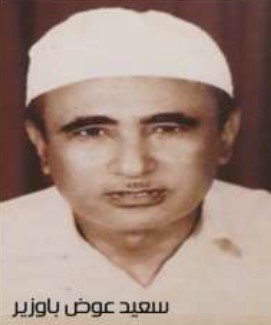
Saeed Awadh Ba Wazir
Historian Born: April 1915, Ghayl Ba Wazir – Hadramout Died: 25 October 1978 Ghayl Bawazir
Saeed Awadh Ba Wazir, a Hadrami historian, writer, and thinker, was born in 1915 and is considered one of the pioneers of the cultural and intellectual movement in Hadramout during the 20th century. He was known for his interest in documenting Hadrami history and calling for the development of education and the dissemination of culture. He left historical and literary works that became important references for researchers studying the history and society of Hadramout.
Biography
Birth and Early Life
Saeed bin Awadh bin Taher Ba Wazir was born in Ghayl Ba Wazir, Hadramout Governorate, on 14 Jumada al-Thani 1333 AH, corresponding to April 1915.
He grew up in a scholarly and cultural environment and received his education from a number of Hadramout's scholars, studying religious sciences, Arabic, and literature before broadening his interests to history, thought, and social issues.
Education and Cultural Formation
He received his education at traditional scholarly institutions in Hadramout and benefited from the gatherings of scholars and writers. He was also interested in reading and following intellectual and political changes in the Arab world.
This formation helped him combine knowledge of heritage with an interest in issues of renewal and reform.
Academic and Professional Career
Ba Wazir worked in the fields of the judiciary, administration, and education, and held official positions during the era of the Qu'aiti Sultanate, including work at the High Judicial Council in Mukalla, followed by serving as deputy judge in Ghayl Ba Wazir.
Alongside his official work, he turned to historical research and writing, devoting a significant part of his life to studying the history of Hadramout and the Arabian Peninsula.
Intellectual and Cultural Activity
Ba Wazir was known for advocating the spread of education and the development of cultural life, and he wrote articles addressing social, educational, and reform issues.
He also took an interest in documenting historical events and social changes, and sought through his works to present Hadrami history in a style combining historical narrative and cultural analysis.
Works and Scholarly Impact
He published a number of books on the history of Hadramout and the Arabian Peninsula, and some of his works became references for researchers and those interested in local history.
His works attracted the attention of cultural institutions, and later academic studies examined his literary, critical, and historical output.
Death
The historian Saeed Awadh Ba Wazir died on Wednesday, October 25, 1978, corresponding to 23 Dhu al-Qi'dah 1398 AH, after a career full of writing, research, and cultural work.
His name has remained present in historical and literary studies addressing the intellectual renaissance in Hadramout during the 20th century.
Works
1. Documenting Hadrami History He authored the book “Pages from Hadrami History,” which addressed aspects of Hadramout's history and its political and social events. 2. Studying the History of the Arabian Peninsula He published the book “Landmarks in the History of the Arabian Peninsula,” contributing historical material for readers and researchers. 3. Writing on Cultural History He wrote the book “Thought and Culture in Hadrami History,” which addressed intellectual and cultural life in Hadramout and its development across historical periods. 4. Advocating the Development of Education He was interested in educational issues and, in his articles, called for expanding knowledge and embracing modern sciences and culture. 5. Participation in Literary Life He wrote poetry and literary and critical articles, and later university studies examined aspects of his literary output. 6. Judicial and Administrative Work He held responsibilities in judicial and administrative institutions in Hadramout during the era of the Qu'aiti Sultanate. 7. Contributing to Cultural Awareness He participated in intellectual and social discussions concerning reform and renewal and influenced a number of Hadrami intellectuals and researchers. 8. Scholarly Recognition After His Death The Union of Arab Historians awarded him the Arab Historian Medal and Certificate in 1998, in recognition of his contributions to historical studies.