
Mail and Telecommunications in Hadramout: From Caravan Letters to the Telephone and Modern Communication Networks
Hadramout witnessed successive transformations in its means of communication, beginning with letters carried by travelers, caravans, and sailing ships, then developing with the emergence of post, telegraph, and telephone offices during the twentieth century. These means helped connect the coastal and valley cities with the outside world and facilitate commercial, family, and administrative correspondence, culminating in the spread of digital communications and the internet.
- Date
- 22 April 1937
- Place
- Not specified
- Ago
- 89 years ago
Historical background
Hadramout’s geography, with its mountains, plateaus, valleys, and deserts, posed major challenges to the movement of letters and information between cities and villages, especially before the emergence of modern transportation and communications.
Letters were carried by travelers, caravans, and merchants, while sea vessels served as a primary means of transporting correspondence between Hadramout’s ports and India, East Africa, and Southeast Asia.
Communication became more important as Hadrami emigration abroad expanded, with correspondence becoming a means of maintaining family ties, managing commercial interests, and conveying news.
During the Sultanate era, more organized postal services began to emerge, before communications infrastructure expanded in later periods with the spread of the telegraph, telephone, and wired and wireless networks.
Details
Before the Official Postal Service: Letters in the Era of Caravans and Ships
Before post offices were established, Hadramout’s residents relied on travelers, merchants, and members of caravans to deliver letters between cities and villages.
Family and commercial correspondence was carried along overland routes linking the valley with the coast, while ships transported letters to Aden, India, and East Asia.
There were no fixed delivery times for letters. Correspondence could take days to arrive within Hadramout, and weeks or longer when sent to distant countries, depending on ship movements, weather conditions, and the availability of transportation.
Late Nineteenth Century: Expansion of Commercial Correspondence
As maritime trade and Hadrami emigration expanded, the need grew for more regular means of sending letters and documents.
Hadrami merchants exchanged correspondence about shipments, money, debts, and commercial partnerships, while families relied on letters to check on their children abroad.
Postal history studies indicate that intermediaries in Aden were used to route correspondence sent from the Qu’aiti Sultanate from 1891, before an official post office opened in Mukalla decades later.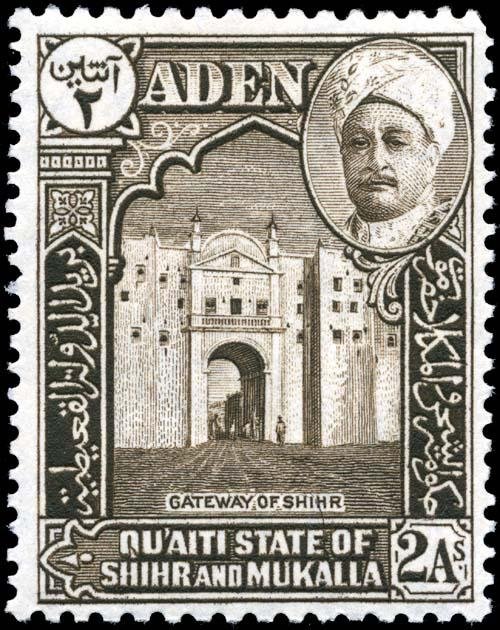
1937: Post Offices Open in Mukalla and Seiyun
The year 1937 marked an important development in the history of postal services in Hadramout, with the opening of two post offices in Mukalla and Seiyun, the administrative centers of the Qu’aiti and Kathiri Sultanates.
Specialized sources state that the Mukalla post office opened on April 22, 1937, while the Seiyun post office opened on May 25 of the same year.
Postal correspondence passed through Aden under the administrative and postal arrangements in place at the time.
The opening of the two offices marked the beginning of a more regular system for receiving, sorting, and directing letters to their local and international destinations.
1939: Arrangements to Unify Postal Services
In February 1939, an agreement was reached to establish a postal union linking Aden with the Protectorates and allowing the use of postage stamps approved within the scope of the agreement.
These arrangements were intended to facilitate the circulation of letters and organize fees and services between areas administered by different authorities.
Historical postal documents indicate that mail between Mukalla and Aden was largely transported by ship, and that seasonal disruption to navigation during some months of the year affected the regularity of the service.
Proposals were also put forward in 1939 to operate regular flights to carry mail to Seiyun, but circumstances related to World War II prevented the proposal from being implemented at the time.
July 1942: Hadrami Postage Stamps
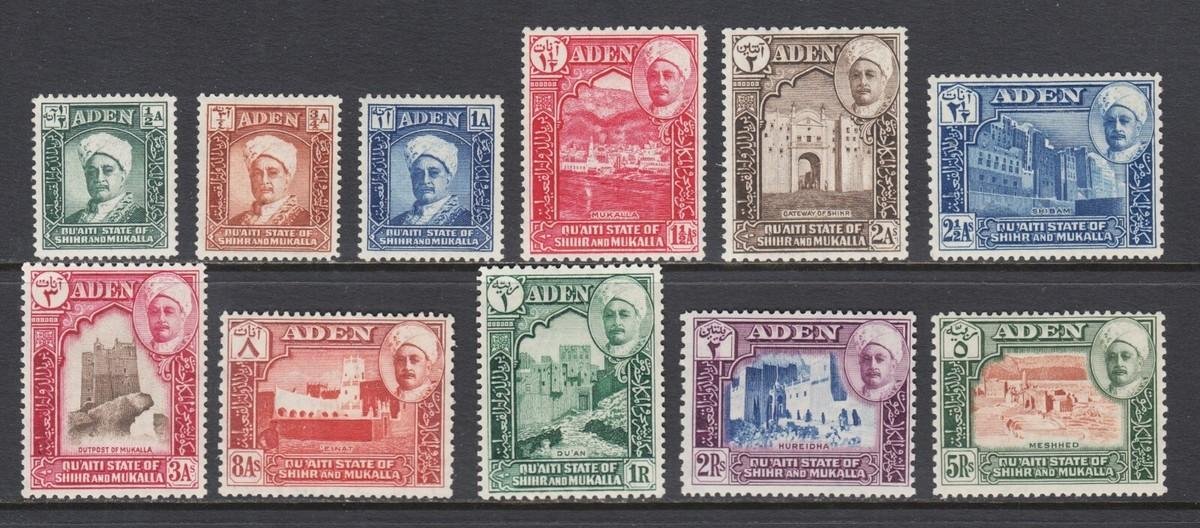
In 1942, the Qu’aiti and Kathiri Sultanates issued their first sets of postage stamps.
The Qu’aiti Sultanate’s stamps bore the name “The Qu’aiti State of Shihr and Mukalla,” while the Kathiri Sultanate’s stamps bore the name “The Kathiri State of Seiyun.”
The designs included images of the sultans and Hadrami landmarks, including scenes of Mukalla, Al-Shihr, Shibam, and Tarim.
The stamps were not merely a means of paying postal fees; they also became documents bearing the names, landmarks, and symbols of the political entities of that period.
According to specialized studies, the first sets were issued in July 1942, although sources differ on the dates when some issues entered circulation.
The 1950s and 1960s: Mail Reaches New Areas
The following decades saw a gradual expansion of the network of postal agencies, extending services to towns and areas beyond Mukalla and Seiyun.
Postal records document the use of registered-mail postmarks and labels in areas such as Daw'an, Hawtat Ahmad bin Zayn, and Dammun, as well as other centers in Hadramout.
These agencies received letters and routed them through the main offices, helping reduce residents’ reliance on travelers to deliver correspondence.
Old envelopes and postmarks reveal city names, dispatch dates, and the routes taken by letters, giving them significant value in the study of local history.
Telegraph and Telephone: The Transmission of Voice and Information
As communications technology developed worldwide, telegraph and telephone services gradually began to reach cities in the region during the twentieth century, followed in later periods by the expansion of wired and wireless communications services.
In Hadramout, the development of communications was linked to the need to facilitate administrative and commercial work and connect population centers, particularly Mukalla and Seiyun.
Nevertheless, the references that could be verified here do not provide a conclusive document establishing the date when the first telephone exchange or telegraph station in Hadramout began operating. Therefore, it would not be appropriate to attribute a specific year to the start of those services without consulting the original technical and administrative records.
After 1967: Reorganization of Services
After the end of Sultanate rule in 1967, the postal and telecommunications sector entered a new phase under the institutions of the State of South Yemen.
Government services expanded over the following decades, with the introduction of more modern postal, telephone, and intercity communications equipment, although coverage levels remained uneven between urban and rural areas.
Following Yemeni unification in 1990, postal and telecommunications services became part of the unified national institutions. Subsequent years saw the spread of telephone exchanges, cellular networks, and internet services.
The Twenty-First Century: From Paper Letters to Digital Communication
With the spread of mobile phones and the internet, the nature of communication between Hadramout’s residents and the outside world changed.
Phone calls, email, and communication applications came to replace many paper letters that had taken weeks to arrive.
Despite this transformation, old letters, envelopes, stamps, and postmarks remain important historical sources, documenting Hadramout’s commercial and social ties and the transformations of its administrative institutions.
Historical impact
The development of postal and telecommunications services helped reduce geographical isolation between areas of Hadramout and facilitate communication between residents of the coast, the valley, and desert areas.
It also supported commercial activity by speeding up the exchange of documents and information, and helped Hadrami families maintain ties with their children living abroad.
The opening of post offices in 1937 and the issuance of Hadrami postage stamps in 1942 marked two significant milestones in the development of service institutions during the Sultanate era.
Old postal documents have particular historical value, preserving the names of cities, sultanates, and people, and revealing the movement of correspondence, commercial ties, and migration.